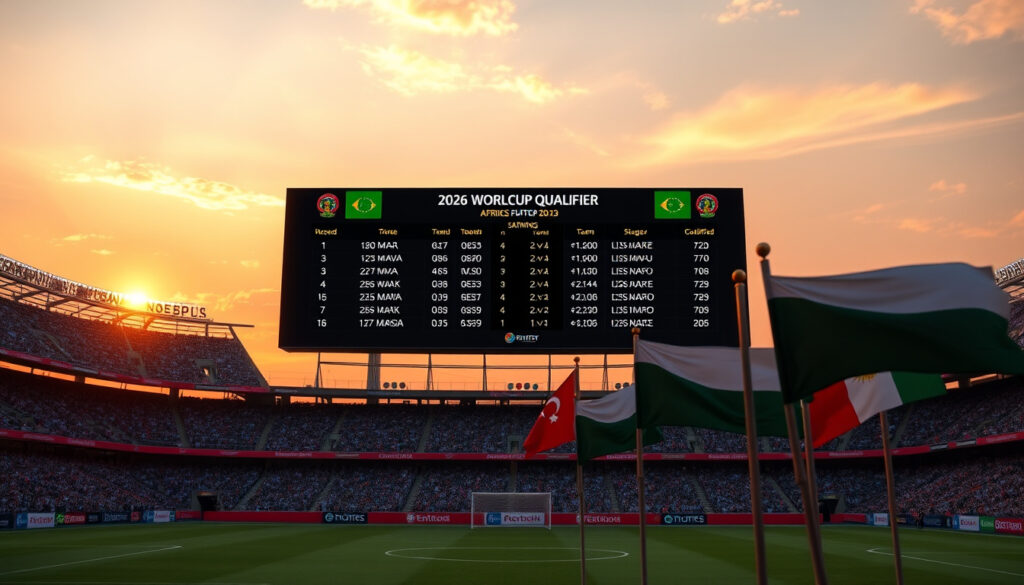
Africa World Cup Qualifiers – 2026 Standings Results Qualified Teams
The CAF qualifiers for the 2026 FIFA World Cup have reached their conclusion, with nine African nations securing their places at the expanded tournament set to be hosted across the United States, Canada, and Mexico. The qualifying campaign featured 54 national teams competing across nine groups, with group winners earning direct qualification while runners-up advanced to a playoff stage.
The African qualification process concluded with several familiar faces confirming their places alongside some notable first-time qualifiers. Egypt topped Group A with 26 points, while Senegal dominated Group B to secure their fourth consecutive World Cup appearance. South Africa emerged from Group C, and Morocco continued their remarkable rise by breaking Spain’s record for most consecutive wins during the campaign.
The expanded World Cup format grants Africa nine guaranteed spots, with an additional place available through the playoff final. The qualifying competition began in November 2023 and featured several dramatic matchdays that determined the final standings across all nine groups.
Current Standings in Africa World Cup Qualifiers
The final group standings revealed clear winners across most groups, though several races went down to the wire. Below is a comprehensive overview of the qualifying positions and points tallies for each group leader.
The nine group winners confirmed their qualification through consistent performances throughout the campaign. Ivory Coast and Algeria topped the points charts with 28 points each, while Morocco’s campaign was historic for breaking consecutive win records.
| Group | Leader | Points | Status |
|---|---|---|---|
| Group A | Egypt | 26 | Qualified |
| Group B | Senegal | 24 | Qualified |
| Group C | South Africa | 24 | Qualified |
| Group D | Cape Verde | — | Qualified |
| Group E | Morocco | 25 | Qualified |
| Group F | Ivory Coast | 28 | Qualified |
| Group G | Algeria | 28 | Qualified |
| Group H | Tunisia | — | Qualified |
| Group I | Ghana | 25 | Qualified |
Group D saw Cape Verde finish at the summit, with Cameroon settling for second place. DR Congo secured an automatic playoff final spot, positioning themselves for a final opportunity to qualify. Madagascar finished as Group I runners-up but were eliminated as one of the five worst runners-up across all groups.
Key Insights from the Qualifying Campaign
- Morocco’s Historic Run: The North African side broke Spain’s record for most consecutive wins during qualification, establishing themselves as one of Africa’s strongest contenders.
- Ghana’s Dominant Display: The Black Stars finished with 8 wins, 1 draw, and 1 loss, scoring 23 goals while conceding only 6 in Group I.
- Nigeria’s Individual Brilliance: Victor Osimhen delivered a hat-trick against Benin, showcasing the attacking talent available to African nations.
- South Africa’s Campaign: Bafana Bafana thrashed Rwanda to secure qualification, demonstrating consistent dominance throughout their qualifying matches.
- Cape Verde’s Breakthrough: The island nation topped their group, marking one of the smaller footballing nations to achieve such success in African qualification.
Latest Results from CAF World Cup Qualifiers
The final round of matches concluded the group stage, with all nine group winners securing their places at the 2026 World Cup. The campaign featured dramatic conclusion across multiple groups, particularly in Group I where Ghana and Madagascar contested the runner-up position until the final matchday.
Several standout performances defined the closing stages. South Africa’s comprehensive victory over Rwanda sealed their qualification mathematically, while Nigeria’s attacking display against Benin produced one of the tournament’s most memorable individual performances. The matches across Groups F and G determined the final points leaders, with Ivory Coast and Algeria finishing tied at the top of their respective groups.
Victor Osimhen’s hat-trick against Benin represented one of the qualifying campaign’s most clinical finishing displays. The Nigerian striker’s performance came during a crucial period when several qualification scenarios remained unresolved across multiple groups.
The final standings reflected consistent performances throughout the campaign rather than dramatic late changes. Teams that established early leads generally maintained their positions, though Group D and Group I provided particular tension as smaller margins separated the leading nations from their nearest challengers.
Which African Teams Have Qualified for 2026 World Cup?
The six directly qualified African nations confirmed their places at the expanded 2026 World Cup. Egypt, Senegal, South Africa, Morocco, Ivory Coast, and Ghana secured their spots as group winners, while DR Congo advanced to the playoff final to contest an additional qualification place.
Morocco’s qualification marked another milestone for African football, with the Atlas Lions building on their historic quarter-final performance at the 2022 Qatar World Cup. Their record-breaking consecutive win streak during qualification underscored their status as serious contenders for the 2026 tournament.
Ghana’s return to the World Cup stage comes after missing the 2022 edition, with the Black Stars delivering a dominant qualifying campaign that saw them lose only once in ten matches. Their 23 goals scored represented one of the most prolific attacking records in African qualification.
Senegal’s qualification marked their fourth consecutive World Cup appearance, establishing them as one of Africa’s most consistent performers on the global stage. South Africa also secured their return, having last featured at the 2010 tournament hosted by their nation.
Senegal’s Qualification Confirmed
The Lions of Teranga confirmed their place at the 2026 World Cup by finishing atop Group B with 24 points. Senegal’s qualification represented the culmination of another strong campaign that saw them emerge as one of Africa’s leading footballing nations over the past decade.
Their consistent presence at major tournaments has helped establish a strong footballing culture domestically, with the national team serving as a source of national pride. The qualification came despite facing competition from several capable regional rivals throughout the campaign.
Africa World Cup Qualifiers Format and Qualification Rules
The CAF qualifying competition for the 2026 FIFA World Cup followed a structured format designed to identify Africa’s strongest national teams. The competition featured 54 national teams divided into nine groups of six teams each, with group winners earning automatic qualification for the World Cup.
The runner-up teams from each group advanced to a playoff stage, where additional qualification spots were contested. This two-stage qualification process ensured that all teams had clear pathways to World Cup participation while maintaining competitive balance throughout the campaign.
The expanded 2026 World Cup format granted Africa nine guaranteed qualification spots, an increase from previous tournaments. This expansion reflected the growing prominence of African football on the global stage and provided additional opportunities for nations across the continent.
The qualifying structure divided 54 teams into nine groups of six, with matches played across home and away legs. Group winners qualified directly, while runners-up entered a playoff competition for remaining spots.
How Many Teams from Africa Qualify for 2026
Africa received nine guaranteed qualification spots for the 2026 World Cup, with an additional place available through inter-confederation playoffs. The guaranteed spots were distributed as follows: nine group winners from the CAF qualifying groups earned direct qualification, while the runners-up competed in a playoff format to determine the final African representative.
DR Congo secured the automatic playoff final spot, positioning themselves for one final opportunity to qualify. Madagascar, despite finishing as Group I runners-up, were eliminated as one of the five worst runners-up across all groups, highlighting the competitive nature of the qualifying campaign.
Upcoming Schedule for Africa World Cup Qualifiers
With the group stage concluded, attention now turns to the playoff stage featuring teams that finished as runners-up. The playoff matches will determine the final African representative at the 2026 World Cup, completing the continent’s qualification process.
The playoff stage represents a crucial opportunity for teams that narrowly missed automatic qualification. DR Congo enters the playoff final automatically, with the outcome set to add one more African nation to the confirmed World Cup participants.
FIFA and CAF have yet to announce specific dates for the playoff matches as of the latest updates. Teams involved in the playoff stage will begin preparations for these decisive encounters, which will determine the final allocation of African qualification spots.
The group stage qualifiers have concluded, with attention now focused on playoff arrangements. Specific match dates and venues remain subject to confirmation by CAF and FIFA.
Timeline of Key Qualifying Milestones
The CAF qualifying campaign for the 2026 World Cup unfolded across multiple phases, with key milestones marking significant moments in the competition. The following timeline outlines the progression from campaign launch to final qualification confirmation.
- November 2023: Group stage matches commenced across all nine groups, with initial fixtures establishing early standings.
- Early 2024: Mid-campaign matches continued with several teams establishing leads in their respective groups.
- Mid-2024: Key matchdays produced dramatic results, including Morocco’s record-breaking win streak development.
- Late 2024: Final round of group matches determined qualification outcomes across all groups.
- Campaign Conclusion: Nine group winners confirmed as World Cup qualifiers, playoff stage arrangements finalized.
The qualifying timeline reflected a compressed schedule compared to previous campaigns, with matches scheduled across a concentrated period to accommodate the 2026 World Cup preparation timeline.
Confirmed and Uncertain Elements
The Africa World Cup qualifiers have produced clear outcomes in several areas, though some elements remain subject to ongoing determination. The following comparison outlines what has been established and what requires further confirmation.
| Established Information | Information Awaiting Confirmation |
|---|---|
| Nine group winners confirmed as qualifiers | Playoff match dates and venues |
| DR Congo playoff final position | Final African playoff participant |
| Final group standings and points | Specific World Cup group allocations |
| Record-breaking performances documented | Pre-tournament friendly schedules |
| Qualified team rosters pending | Coach appointments for qualified nations |
The qualified nations have been determined with certainty, though specific tournament details including group stage draw positions remain to be confirmed. The playoff stage configuration continues to be finalized by CAF and FIFA authorities.
Context: African Football’s World Cup Journey
Africa’s representation at the FIFA World Cup has grown steadily since the tournament’s expansion to include African participants. The continent’s qualification of six direct teams for 2026 continues this progression, reflecting improvements in football infrastructure, coaching standards, and competitive depth across African national teams. Those interested in comparing this growth with other international sporting developments may find relevant context in the Dollar Canadien en Dirham Marocain – Taux Actuel et Historique analysis of economic factors influencing international competitions.
The 2026 qualification campaign witnessed several African nations demonstrating significant growth. Morocco’s record-breaking performance and Ghana’s dominant campaign highlighted the increasing competitiveness of African football on the continental stage.
The expanded World Cup format provides additional African nations with opportunities to compete at football’s highest level. This expanded participation creates pathways for smaller footballing nations to develop through major tournament experience, potentially strengthening African football’s global standing in future cycles.
Sources and Official Statements
CAF and FIFA officials have provided updates throughout the qualifying campaign, with both organizations maintaining official channels for qualification announcements and tournament information. The following sources have contributed to the documented information in this coverage.
CAF confirmed the group stage conclusions with official standings released through multiple platforms, verifying the qualification status of all nine group winners.
— CAF Official Communications
FIFA’s tournament coverage has maintained detailed records of all African qualification matches, providing comprehensive data for analysis of team performances and qualification scenarios.
Multiple sporting publications including ESPN and African Football have provided independent verification of official records, with Wikipedia maintaining detailed documentation of qualification history and results.
Summary: Africa World Cup Qualifiers 2026
The Africa World Cup qualifiers for the 2026 FIFA World Cup have concluded with six nations securing direct qualification and DR Congo advancing to the playoff final. Egypt, Senegal, South Africa, Morocco, Ivory Coast, and Ghana will represent Africa at the expanded tournament, with Morocco’s record-breaking campaign standing as a particular highlight. The qualifying process demonstrated the competitive depth of African football, with strong performances from multiple nations throughout the campaign. Fans seeking additional sports coverage may explore analysis of the Pakistan National Cricket Team vs South Africa National Cricket Team – Head-to-Head Records & Schedule for comparison with other international sporting competitions.
Frequently Asked Questions
Which African teams qualified for the 2026 World Cup?
Egypt, Senegal, South Africa, Morocco, Ivory Coast, and Ghana qualified directly as group winners. DR Congo advanced to the playoff final for an additional spot.
How many African teams qualify for the 2026 World Cup?
Africa has nine guaranteed qualification spots, with an additional place available through the playoff competition involving runners-up from the qualifying groups.
What format did the CAF qualifiers use?
The qualifiers used a 9-group format with teams divided into groups of six. Group winners qualified automatically, while runners-up advanced to a playoff stage.
When did the Africa World Cup qualifiers start?
The qualifying campaign began in November 2023, with matches played across multiple stages until the group stage conclusion determined all qualification outcomes.
Who are the favorites to qualify from Africa for World Cup 2026?
Morocco emerges as a leading contender following their record-breaking qualifying campaign and quarter-final achievement at the 2022 World Cup. Senegal and Ghana also demonstrated strong form throughout qualification.
Which players stood out during African qualification?
Victor Osimhen delivered a memorable hat-trick against Benin, while Morocco’s collective achievement of breaking Spain’s consecutive win record highlighted individual and team excellence during the campaign.
What happened to Madagascar in qualification?
Madagascar finished as Group I runners-up but were eliminated as one of the five worst runners-up across all groups, missing out on the playoff stage despite their second-place finish.
More related posts
 164 cm in Feet: Exact Conversion & 5’4″ vs 5’5″ Guide
 Mark McMorris: Accident, Net Worth, and Comeback
 CAD to INR: Convert Canadian Dollars to Indian Rupees
 M*A*S*H Actors: Salaries, Feuds & Who’s Still Alive
 80 F to C – Precise Conversion to 26.67 Degrees Celsius
 Paul Stanley: Disability, Net Worth, and His Hair Wig Truth
 Harley Guindon: Convictions, Business, Hells Angels Feud
 Internationaux des États-Unis 2025 – Dates, Schedule, Tickets Guide
