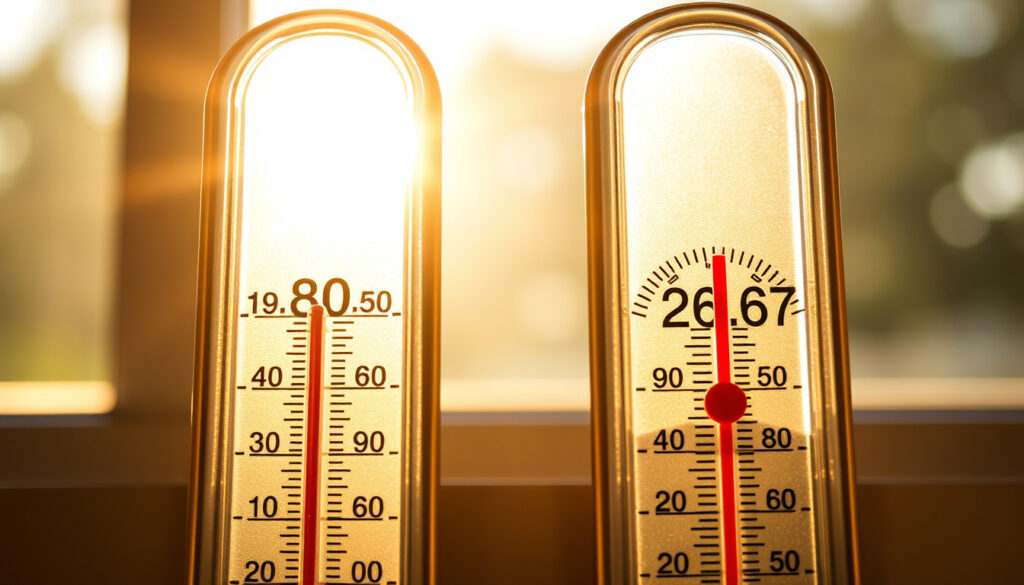
80 F to C – Precise Conversion to 26.67 Degrees Celsius
Converting temperatures between Fahrenheit and Celsius is a common task when traveling, cooking, or interpreting weather data from different regions. When you need to know what 80°F equals in Celsius, the precise answer is 26.67°C, calculated through a straightforward mathematical formula that has been standardized for international use.
Understanding this conversion becomes particularly useful when comparing weather forecasts, adjusting recipes from US-based sources, or working with scientific data that may use either temperature scale. The relationship between these two scales is fixed, meaning any temperature can be accurately converted using the same mathematical approach.
This guide provides the exact conversion for 80°F to Celsius, explains the calculation method, offers context for what this temperature feels like, and covers the historical background of both temperature scales. Whether you need a quick answer or a deeper understanding of the conversion process, the information below addresses the most common questions related to this temperature conversion.
What is 80°F in Celsius?
Eighty degrees Fahrenheit equals 26.67 degrees Celsius. This conversion is precise and follows the standard mathematical relationship between the two temperature scales. When rounded for everyday use, 80°F is often referred to as approximately 27°C, though the exact figure provides greater accuracy for scientific and technical applications.
Key Insights
- 80°F is precisely 26.666…°C, which is typically rounded to 26.7°C for practical use
- This temperature commonly appears in US weather reports during summer months
- The conversion involves subtracting 32 from the Fahrenheit value, then multiplying by 5/9
- At 80°F, most people find outdoor activities comfortable without excessive heat
- The human comfort range for indoor environments typically falls between 68-76°F, making 80°F warm for enclosed spaces
- A NASA temperature chart shows that 81°F corresponds to 27.2°C, confirming the expected progression of the conversion scale
Quick Reference Table
| Metric | 80°F Value | Notes |
|---|---|---|
| Celsius | 26.67°C | Exact mathematical result |
| Feels Like | Warm | Comfortable for outdoor activities |
| Boiling Point F | 212°F | Reference point: 100°C |
| Freezing Point F | 32°F | Reference point: 0°C |
| Difference from 81°F | 0.53°C lower | 81°F = 27.2°C per NASA data |
How to Convert 80°F to Celsius
The conversion from Fahrenheit to Celsius follows a two-step mathematical process that produces accurate results every time. Understanding this formula allows you to convert any Fahrenheit temperature to its Celsius equivalent, not just 80°F.
The Standard Formula
The complete conversion formula is °C = (°F − 32) × 5/9. This formula accounts for the different starting points and scaling intervals of the two temperature scales. The Fahrenheit scale sets the freezing point of water at 32°F, while the Celsius scale uses 0°C as its freezing point reference.
Applying this formula to 80°F involves two distinct calculation steps. First, you subtract 32 from 80, which gives you 48. Second, you multiply 48 by the fraction 5/9, which equals approximately 0.556. This multiplication yields the final result of 26.67°C.
Step 1: 80 − 32 = 48. Step 2: 48 × 5/9 = 26.666…°C. The repeating decimal is typically rounded to 26.67°C for practical applications.
Alternative Calculation Methods
An alternative approach uses division by 1.8 instead of multiplication by 5/9, since these operations are mathematically equivalent. The formula °C = (°F − 32) ÷ 1.8 produces the same result through a different computational path.
For quick mental estimates, a simplified approximation formula subtracts 30 from the Fahrenheit temperature and divides by 2. Using this method with 80°F gives (80 − 30) ÷ 2 = 25°C. While this approximation is convenient for rapid estimates, it introduces a small margin of error compared to the exact calculation.
Understanding the Conversion Logic
The Fahrenheit and Celsius scales diverge in both their reference points and the size of their degree intervals. Fahrenheit divides the range between the freezing and boiling points of water into 180 degrees (212 − 32 = 180), while Celsius uses 100 degrees (100 − 0 = 100). This 180-to-100 ratio simplifies to the 9-to-5 relationship embedded in the conversion formula.
What Does 80°F Feel Like?
Eighty degrees Fahrenheit is generally perceived as a warm temperature, comfortable for most outdoor activities but potentially warm for enclosed indoor spaces without air conditioning. The perception of 80°F can vary based on humidity levels, sun exposure, wind conditions, and individual tolerance.
Outdoor Experience
At 80°F, outdoor conditions are typically pleasant for activities such as walking, hiking, cycling, and casual sports. The temperature is warm enough for swimming and sunbathing but not extreme enough to pose significant heat-related health risks for healthy individuals spending limited time outdoors.
Direct sunlight can make 80°F feel considerably warmer, while shade or gentle breezes can enhance comfort. Many weather services consider 80°F to be an ideal temperature for outdoor recreation and typically associate it with favorable conditions for picnics, park visits, and other outdoor gatherings.
Indoor Comfort
Indoor environments at 80°F may feel warm to many people, particularly during physical inactivity. The recommended indoor comfort range for most building standards falls between 68°F and 76°F, making 80°F above the typical comfort threshold for enclosed spaces.
This temperature is common in regions that primarily use the Fahrenheit scale, including most of the United States. During summer months, outdoor temperatures regularly reach 80°F and higher across much of the country, and weather forecasts frequently report this temperature during heat waves.
Thermostat settings in US homes typically range from 68-72°F during cooling season. Reaching 80°F indoors often indicates that cooling systems are insufficient, windows are exposed to direct sunlight, or the space lacks proper ventilation.
Regional Variations
The significance of 80°F differs across regions based on local climate norms and infrastructure. In Mediterranean climates, 80°F represents a moderately warm day. In tropical regions, it may be considered a cooler day during hotter periods. In temperate zones, this temperature often signals summer conditions.
Fahrenheit to Celsius Conversion Basics
Understanding how Fahrenheit and Celsius relate to each other provides context for interpreting temperatures from different countries and scientific sources. Both scales measure temperature but use different reference points and degree intervals.
The Two Scales Explained
The Fahrenheit scale, developed by Daniel Gabriel Fahrenheit in 1724, originally defined zero degrees as the coldest temperature achievable using a specific mixture of salt and ice. The scale was later refined to use the freezing and boiling points of water as reference points, with 32°F for freezing and 212°F for boiling at standard atmospheric pressure.
The Celsius scale, introduced by Anders Celsius in 1742, originally set zero degrees at the boiling point of water and 100 degrees at freezing, later inverted to the current arrangement. This scale defines the freezing point of water as 0°C and the boiling point as 100°C at standard atmospheric pressure, making it more intuitive for scientific work.
Why Both Scales Persist
The continued use of both scales reflects historical, cultural, and practical factors. The United States, along with a handful of other countries, predominantly uses Fahrenheit for everyday temperature reporting, including weather forecasts and consumer thermometers. Most other nations adopted Celsius following metric system implementation, as it integrates more naturally with other metric measurements.
Scientific communities worldwide use Kelvin for absolute temperature measurements, but Celsius remains standard for reporting temperatures related to weather, climate, and everyday applications in most countries. This dual-system reality means that conversion knowledge remains practically useful for international communication.
Weather reports often round temperatures to whole numbers for readability. The difference between 26.67°C and 27°C is minor for most purposes, but precision matters in scientific, medical, and technical contexts where exact values are specified.
Common Conversion Reference Points
Memorizing key reference points can help estimate conversions without calculations. Water freezes at 32°F (0°C), boils at 212°F (100°C), and room temperature is commonly cited as 68-72°F (20-22°C). These anchors provide mental reference for estimating other conversions quickly.
The conversion between scales becomes more intuitive with practice. A useful rule of thumb is that each Celsius degree equals 1.8 Fahrenheit degrees, meaning the two scales diverge more significantly at extreme temperatures while being relatively close in the moderate range where most everyday temperatures fall.
The History of Temperature Scales
The development of temperature measurement scales reflects centuries of scientific advancement and practical necessity. Understanding when and why these scales emerged provides useful context for appreciating their continued use today.
- 1724 — Daniel Gabriel Fahrenheit introduced the Fahrenheit scale, using mercury thermometers and establishing the 32°F freezing point of water as a reference
- 1742 — Anders Celsius proposed the centigrade scale, later inverted to become the modern Celsius scale with 0°C at the freezing point of water
- 1948 — The International Bureau of Weights and Measures officially adopted Celsius as the preferred name for the centigrade scale
- 1960s-70s — Most countries transitioned to Celsius as part of metric system adoption, with the United States remaining as a notable exception
Understanding Conversion Accuracy
The mathematical conversion from 80°F to Celsius is exact with no inherent uncertainty in the formula itself. Any imprecision comes from rounding decisions rather than the conversion calculation.
| Established Information | Information That Remains Unclear |
|---|---|
| Formula produces 26.666…°C mathematically | Preferred rounding convention varies by field |
| Conversion method is universally standardized | Humidity and wind factors affecting perceived temperature |
| 80°F is 26.67°C when rounded to two decimal places | How different countries report fractional temperatures |
For general purposes, rounding to 27°C is acceptable. For scientific, medical, or technical applications, maintaining two decimal places (26.67°C) provides appropriate precision and avoids cumulative rounding errors in calculations.
Real-World Applications
Converting temperatures like 80°F to Celsius proves useful in various practical situations. International travelers frequently encounter Fahrenheit-based weather information when visiting the United States and need to interpret conditions accurately. Recipe adjustments require temperature conversions when adapting dishes between US and metric-system cookbooks.
Scientific data, engineering specifications, and medical instructions may use either scale depending on their origin. Understanding the conversion allows accurate interpretation regardless of which scale appears in the source material. HVAC professionals, laboratory technicians, and healthcare providers regularly perform such conversions when working with equipment or documentation from different regions.
The ability to quickly estimate conversions without tools also has value. Knowing that 80°F is approximately 27°C provides sufficient accuracy for most daily decisions about clothing, activity planning, and comfort management. The mental shortcut of subtracting 30 and dividing by 2 yields 25°C, which is close enough for rapid estimates while recognizing that the exact value is 26.67°C.
Official Standards and References
Temperature measurement standards are maintained by national and international organizations to ensure consistency and accuracy across scientific and commercial applications.
The National Institute of Standards and Technology (NIST) maintains official definitions and standards for temperature measurement in the United States, providing reference materials for calibrating thermometers and validating conversion calculations.
— NIST.gov temperature standards
The conversion formula itself derives from the physical properties of water at standard atmospheric pressure, where the freezing and boiling points provide fixed reference temperatures for both scales. This physical basis ensures that conversions remain consistent regardless of location or measuring instrument.
Quick Reference Summary
Eighty degrees Fahrenheit equals 26.67 degrees Celsius, calculated using the formula (°F − 32) × 5/9. This temperature represents warm conditions comfortable for outdoor activities but potentially warm for enclosed indoor spaces. The conversion is exact with no inherent uncertainty in the mathematical formula; any imprecision comes from rounding choices for specific applications.
For related conversion guides and practical temperature reference materials, explore additional conversion resources available on this site.
Frequently Asked Questions
What is the formula to convert Fahrenheit to Celsius?
The formula is °C = (°F − 32) × 5/9. Subtract 32 from the Fahrenheit value, then multiply by 5/9 (or divide by 1.8) to obtain the Celsius equivalent.
Is 80°F hot or cold?
Eighty degrees Fahrenheit is considered warm. It is comfortable for most outdoor activities but may feel warm indoors without air conditioning. Most people find it pleasant for recreation and outdoor events.
Why does the Fahrenheit scale use 32 as the freezing point?
Daniel Gabriel Fahrenheit originally set zero at the coldest temperature achievable with a salt-ice mixture. After experimentation, he adjusted the scale so that 32°F would represent the freezing point of water, creating a more reproducible reference point.
What countries use Fahrenheit?
The United States, its territories, and a few Caribbean nations primarily use Fahrenheit for everyday temperature reporting. Most other countries use Celsius as part of the metric system.
How do I quickly estimate Fahrenheit to Celsius in my head?
Subtract 30 from the Fahrenheit temperature and divide by 2. This approximation yields results close to the exact conversion, though it may be off by 1-2 degrees for most everyday temperatures.
What is the difference between Celsius and Centigrade?
There is no practical difference. Celsius and centigrade both refer to the same temperature scale with 0°C at water’s freezing point and 100°C at its boiling point. The name was officially changed from centigrade to Celsius in 1948.
More related posts
 Scott Steiner: Biography, Net Worth, WWE Exit, and Current Updates
 Olivia Culpo: Biography, Health Battle, and Family Life
 Nina Dobrev: Age, Net Worth, Relationships & Health
 Miku Martineau: Age, Height, Movies, and Complete Biography
 Cineplex Odeon South Edmonton Cinemas: Showtimes, Tickets & Guide
 Washington Open 2025: Prize Money, Dates & Winners
 Linda McCartney: Cause of Death, Funeral, and Legacy (2025)
 Martine St-Clair: Age, Husband, Net Worth, Songs & Paintings
