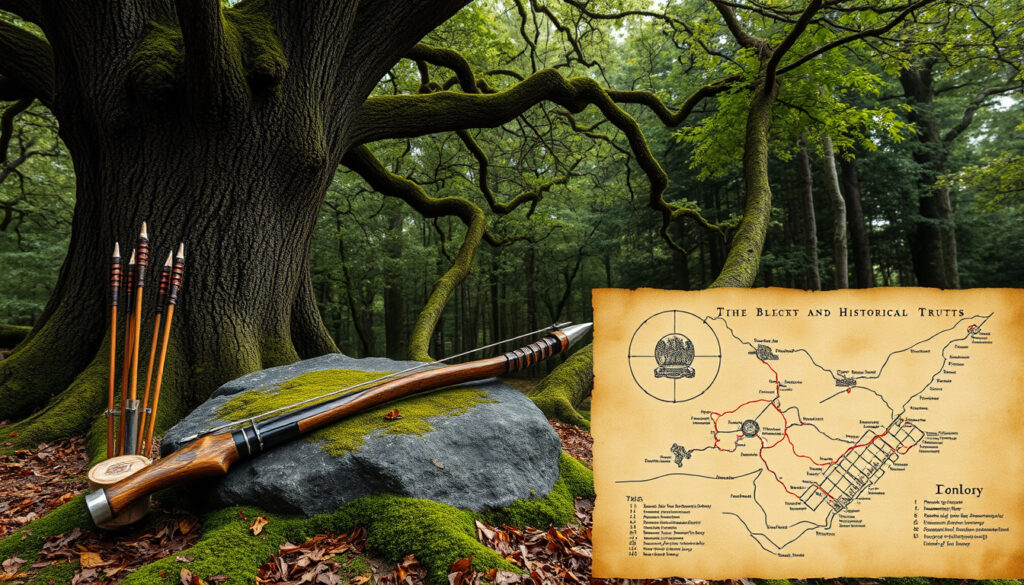
Robin Hood Legend: Separating Historical Fact from Fiction
Few figures in English folklore spark as much curiosity as Robin Hood. Everyone knows the basics: an outlaw who robbed the rich to feed the poor. But the story we tell today is not the same one that first appeared in medieval ballads. This article pieces together what the earliest sources actually say — and what remains firmly in the realm of fiction.
First known mention: c. 1377 (poem Piers Plowman) · Earliest ballads: c. 1450–1500 · Setting: Sherwood Forest, Nottinghamshire · Notable companions: Little John, Friar Tuck, Maid Marian · Primary source of legend: English folklore
Quick snapshot
- Outlaw of English folklore (BBC Bitesize (UK educational resource))
- Merry Men companions (Visit Sherwood (official tourism site))
- Robs from rich, gives to poor – but this motif appears later (see card 2) (BBC Bitesize (UK educational resource))
- No single proven source (BBC Bitesize)
- Possible composite figure – “Robin Hood” may have been an alias used by multiple outlaws (BBC Bitesize)
- Earliest stories from 14th–15th century (Visit Sherwood)
- National Nature Reserve – still exists as a protected area (Visit Sherwood)
- Home of the Major Oak (Visit Sherwood)
- Visitor attractions and events year-round (Visit Sherwood)
- Numerous film and TV adaptations since the 1920s
- 1960s Disney animated version
- 2018 film ‘Robin Hood’ starring Taron Egerton
Four facts, one pattern: the core legend is centuries old, but the details were stitched together over time. The table below shows the earliest known references.
| Label | Value |
|---|---|
| Earliest Known Reference | c. 1377 (in Piers Plowman) – Visit Sherwood |
| First Ballads | c. 1450–1500 (Robin Hood and the Monk, Robin Hood and the Potter) – Bold Outlaw (ballad scholarship) |
| Typical Social Status in Ballads | Yeoman (commoner) – BBC Bitesize |
| Primary Location (early) | Barnsdale, Yorkshire, as well as Sherwood – Medievalists.net (academic history site) |
| Classic Adversary | Sheriff of Nottingham |
| First Association with King Richard I | Sir Walter Scott’s Ivanhoe (1820) – BBC Bitesize |
| First Explicit “Robs Rich to Give to Poor” | John Stow’s Annales (1592) – Wikipedia |
The implication: what we think of as the Robin Hood story is a slow build across centuries, not a single biography.
Who is Robin Hood and what did he do?
Early ballads and the first tales
- The earliest surviving narrative ballads, such as Robin Hood and the Monk (c. 1460) and Robin Hood and the Potter (late 1460s), present Robin as a quick-tempered yeoman, not a dispossessed nobleman (Bold Outlaw).
- The earliest ballads do not mention King Richard or the Crusades; they focus on local conflicts with the Sheriff and clergy.
- The foundational ballad A Lytell Geste of Robyn Hode (mid-15th century) already includes the core group of Merry Men and the setting of Sherwood and Barnsdale (Visit Sherwood).
Core actions: robbing the rich and giving to the poor
- Surprisingly, the “give to the poor” element is not prominent in the earliest ballads. The first clear statement that Robin Hood regularly robbed the rich to help the poor appears in John Stow’s Annales of England (1592) – more than 200 years after the first mention (Wikipedia).
- Earlier ballads stress Robin’s defiance of corrupt authority and his generosity to his own band, but not systematic charity to the poor.
Key companions and foes
- Little John, Will Scarlet, and Much the Miller’s Son appear in the earliest ballads. Friar Tuck and Maid Marian enter the tradition later, in the 15th and 16th centuries.
- The Sheriff of Nottingham is the central antagonist from the start; the earliest ballads show Robin outsmarting him repeatedly.
What this means: the Robin Hood we know today is a composite whose most famous trait – giving to the poor – was an afterthought added long after the first stories.
Modern storytellers turned a yeoman outlaw into a noble crusader. The original Robin was more like an early folk hero with a short temper and a talent for archery than a socialist icon.
Is Robin Hood a true story?
The lack of contemporary historical records
- No chronicle from the 12th or 13th century mentions a person named Robin Hood who matches the legend. The first literary reference is in William Langland’s Piers Plowman (c. 1377), where a character says he knows “Rymes of Robyn Hood” (Visit Sherwood).
- A 1439 petition to Parliament uses “Robin Hood” as a label for an itinerant felon – suggesting the name was already a catchall for outlaws.
Possible real-life inspirations
- A 1226 York Assizes record mentions a Robert Hod whose goods were confiscated and who became an outlaw.
- Some historians argue that “Robin Hood” was an alias used by multiple outlaws over more than a century (BBC Bitesize).
The role of the ballad tradition
- Ballads were oral and fluid; each performer could add or change details. This makes it nearly impossible to pin down a single “original” story.
- The ballad Robin Hood and Guy of Gisborne and the Gest both set Robin in Barnsdale, Yorkshire, not Sherwood – showing that the geography was flexible (Medievalists.net).
The pattern: the legend is built on a foundation of multiple potential real outlaws and centuries of folk invention. There is no “one true Robin Hood.”
What was Robin Hood best known for?
Skill as an archer
- Every early ballad highlights Robin’s unmatched archery. In Robin Hood and the Monk, he splits an arrow on a target – a feat that reinforces his status as a folk champion (Bold Outlaw).
His code of honor and justice
- Robin robs from corrupt clergy and officials, but he respects the Virgin Mary and aids the downtrodden – a moral code that set him apart from common outlaws.
- This code later evolved into the “robs from the rich, gives to the poor” slogan, but in the early ballads it is more about personal loyalty and anti-authority sentiment.
Defiance of authority (the Sheriff of Nottingham)
- The Sheriff is the repeated villain. Robin’s clever escapes and direct confrontations with the Sheriff form the plot of several early ballads.
Why this matters: the core of the Robin Hood character is his outlaw status combined with a sense of honor – not the Robin Hood of Disney, but a more complex, rough-edged figure.
What was the cause of Robin Hood’s death?
Betrayal by the prioress of Kirklees
- In the most widely known version (from A Gest of Robyn Hode and later retellings), Robin Hood is betrayed by the prioress of Kirklees Priory, who bleeds him to death after he is wounded.
- He is said to have shot a final arrow asking to be buried where it lands – a dramatic ending retold in many adaptations.
Final arrow and burial place
- The spot of his burial is traditionally said to be near Kirklees Hall in West Yorkshire, though no definitive grave exists.
Variations in different versions of the tale
- Some versions attribute his death to natural causes or illness. The betrayal story is the most dramatic and has become the standard in popular culture.
The trade-off: the death story – like the life story – is folklore, not documentary history. It serves the narrative, not the archive.
Does Sherwood Forest still exist?
The modern Sherwood Forest National Nature Reserve
- Yes. Sherwood Forest is a real protected area in Nottinghamshire, designated a National Nature Reserve. It covers about 1,000 acres of ancient woodland.
The Major Oak and its significance
- The Major Oak, estimated to be around 800–1000 years old, is the most famous tree in the forest. Folklore says Robin Hood used it as a hideout (Visit Sherwood).
- It is supported by an elaborate frame to protect its massive limbs, and it attracts hundreds of thousands of visitors annually.
Visitor information
- The Sherwood Forest Visitor Centre offers trails, exhibitions, and events. It remains a top destination for anyone exploring the Robin Hood legend.
What this means: the physical setting of the legend is very much alive, and it provides a tangible link to the stories.
Sherwood Forest is the one part of the Robin Hood story that can be verified with a visit. The legend may be fuzzy, but the forest is real – and it keeps the legend grounded in a specific place.
Timeline signal
- c. 1377 – First literary mention in William Langland’s Piers Plowman (Visit Sherwood)
- c. 1450–1500 – Collection of early Robin Hood ballads (Robin Hood and the Monk, Robin Hood and the Potter) (Bold Outlaw)
- 1521 – John Major’s Historia Majoris Britanniæ places Robin in the reign of Richard I (Wikipedia)
- 1592 – John Stow’s Annales first explicitly states Robin Hood stole from the rich to give to the poor (Wikipedia)
- 1598 – Anthony Munday’s play turns Robin Hood into the Earl of Huntingdon (Wikipedia)
- 1820 – Sir Walter Scott’s Ivanhoe solidifies the noble outlaw image and ties him to Richard I (BBC Bitesize)
- 1938 – Errol Flynn’s The Adventures of Robin Hood defines the cinematic version (Wikipedia)
- 1973 – Disney’s animated Robin Hood features a fox as the hero (Wikipedia)
- 2018 – Film Robin Hood starring Taron Egerton
The pattern: each era reshaped Robin Hood to fit its own values – from medieval yeoman to Victorian gentleman to CGI action hero.
Confirmed facts vs. what’s unclear
Confirmed facts
- Robin Hood is a core figure of English folklore with references dating to the 14th century.
- Sherwood Forest is a real location in Nottinghamshire, still preserved as a nature reserve (Visit Sherwood).
- The earliest surviving ballads date to the late 15th century.
- There is no contemporary historical record of Robin Hood’s life from the 12th or 13th century (BBC Bitesize).
- The “rob from rich, give to poor” motif is first documented in 1592, not in the early ballads.
What’s unclear
- Whether Robin Hood was one real person, a composite, or pure fiction – historians remain divided.
- The exact details of the original plot of the Robin Hood story.
- Whether the earliest Robin Hood was a yeoman from Yorkshire’s Barnsdale or from Nottinghamshire’s Sherwood – both appear in early sources (Medievalists.net).
- How much of his death story is based on any real event – the Kirklees betrayal is a literary invention.
- The exact date of Robin Hood’s first appearance in literature is uncertain – the 1377 reference is to a poem that mentions rhymes of Robin Hood, not necessarily a full story.
The implication: the legend is a mix of verifiable locations and oral traditions, not a single historical record.
Quotes from scholars and sources
“The Robin Hood we know today is a product of the 16th century, not the 13th. The early ballads show a very different kind of outlaw – more violent, less altruistic.”
Professor Stephen Knight (Robin Hood scholar), Robin Hood: A Complete Study of the English Outlaw
“There is just as much evidence against a single historical Robin Hood as for one. The name seems to have been an alias used by any number of medieval criminals.”
Historic UK (editorial), “Robin Hood – Fact or Fiction?” (Historic UK via BBC Bitesize)
“The earliest ballads set Robin in Barnsdale as often as in Sherwood. The link with Nottinghamshire became dominant only in later centuries, partly because of tourism.”
Medievalists.net (2019), “Robin Hood in Sherwood Forest and Barnsdale” (Medievalists.net)
The consequence for anyone looking for a definitive answer: the Robin Hood we think we know is a cultural collage, assembled over six centuries. The most honest answer to “Is he real?” is: he is as real as the stories we keep telling. For the modern reader tempted to take the Disney version as gospel, the lesson is clear: go back to the ballads, or accept that the truth is far messier – and far more interesting.
themysteryofhistory.com, medievalists.net, visittunbridgewells.com, imdb.com, historic-uk.com, facebook.com, youtube.com, onceuponatime.fandom.com
For readers wanting to separate fact from fiction, a detailed examination of the true story of the outlaw provides additional historical context.
Frequently asked questions
Did Robin Hood really steal from the rich and give to the poor?
Not in the earliest ballads. That specific phrasing first appears in John Stow’s 1592 Annales. Earlier poems focus on Robin’s defiance of corrupt officials and generosity to his own band, not a systematic redistribution of wealth (Wikipedia).
What is the significance of the Major Oak in Sherwood Forest?
The Major Oak is an ancient tree estimated to be 800–1,000 years old. Legend claims Robin Hood used it as a hideout, and it has become an iconic symbol of Sherwood Forest (Visit Sherwood).
How many Robin Hood movies have been made?
There are dozens of film and television adaptations. The most influential include the 1938 Errol Flynn version, Disney’s 1973 animated version, and the 2018 film starring Taron Egerton.
Was Maid Marian a historical figure?
No. Maid Marian first appears in 16th-century May Day plays and later in Anthony Munday’s plays. She was not part of the earliest Robin Hood ballads.
What does the phrase “rob from the rich and give to the poor” mean?
It is the popular summary of Robin Hood’s mission. The phrase became widely known after John Stow’s work and was cemented by later literature and films. It symbolizes social justice but does not reflect the actions in the earliest ballads.
When was the first Robin Hood story written down?
The first surviving Robin Hood ballads date from around 1450–1500. The earliest reference to the character comes from Piers Plowman (c. 1377) (Visit Sherwood).
Is Sherwood Forest free to visit?
Yes, many parts of Sherwood Forest National Nature Reserve are open to the public for free. The visitor centre and some events may have charges.
How is the Robin Hood investment app related to the legend?
The Robinhood investment app is named after the outlaw, implying that it helps ordinary people, but it is a commercial entity with no connection to the folklore.
The questions above cover the most common curiosities about the outlaw.
More related posts
 Dads Gifts: The Ultimate Guide for Irish Father’s Day & Christmas 2025
 Native American Identity: Legal, Cultural & Genetic Basics
 Andrea Bocelli: Biography, Blindness, Songs, and Family
 Molly Ringwald: Net Worth, Children, and Judd Nelson Incident
 Sid Vicious: Biography, Death, and Nancy Spungen Story
 Ben Stiller: Cancer, Career Hiatus, Marriage Reconciliation
 Marie-Philip Poulin Barred French – Olympics Press Controversy Explained
 Condos for Sale Thunder Bay – Listings Prices Analysis
